Anne-Laure Le Cunff's Tiny Experiments
Review and short notes on Anne-Laure Le Cunff's Tiny Experiments - How to live freely in a goal-obsessed world
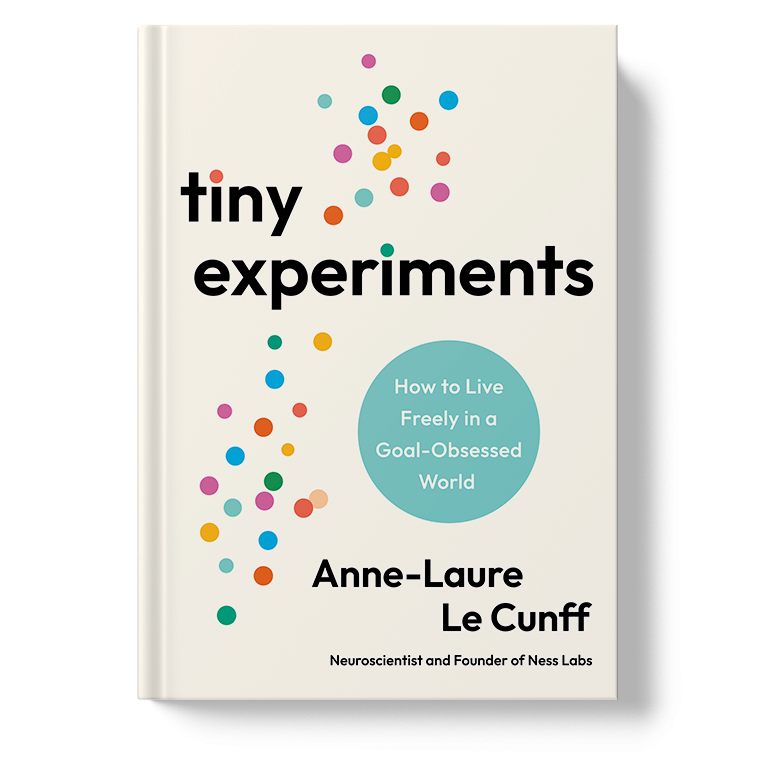
Every few months or years, the goal-setting, habit-forming, self improvement, grind mindset space is graced with a new and trendy self-help book on how to improve our lives. This book is no exception, but one that is important to me for personal reasons.
When I started this blog, I started following and subscribing to other newsletters - primarily to learn how this whole thing worked but also to have something in my inbox to read. I'm still subscribed to some of these newsletters.
One of these newsletters was Anne-Laure's Ness Labs newsletters. I enjoyed reading them because they were all about psychology and if I haven't made it my whole personality yet, I was a psychology major ✌️ So when Anne-Laure announced that she was having a meet-up in Singapore, I jumped upon the chance and attended it.
She's great in person! And the meet-up turned out to be a mini-networking/talk-to-one-another session instead of a one-way static meet-and-greet because she's, well, French (I don't know what it is but French people looooove socialising). And this was after she announced the book was going to be published! I was very excited. At the end of the session, we spoke about being in long-distance relationships, living in France (I was preparing to move) and just stuff to do in Singapore.
So I knew the book was coming out. But I was also (still am) at the point in my life where I no longer buy books (for economic and environmental reasons). Hence, I didn't pre-order a copy. I knew it was going to be available on NLB eventually.
It was on hold FOR MONTHS as soon as it was available on NLB. I finally got to read it here in France (I'm a Singaporean, so I still have access to the digital library via my tablet/kobo 😛). I've heard and read a lot about some of the things discussed in the books, either through podcasts that Anne-Laure guested, or reiterated by other content creators when they discuss learning or goal settings, and on the new-ish topic of "personal curriculum".
The gist of it: linear goals are bad, so are "follow your passion" goals, because it makes you feel like shit. The alternative: doing tiny experiments in your day to day life for a set amout of time to figure out what you want or like. Decide if you want to continue. Look at life like a science experiment. Track everything. Track everything in public for collaborative learning (OR PUBLIC SHAMING - just kidding). Life is fun. Don't limit yourself to the definition of your job. Slasheurs (French for Slashers) are a thing. Woohoo!
I will be writing a form of sparknotes of the book for me to keep coming back to when I want to refresh my memory of the book. But if you wanted a rating, here it is: 4/5.
I found the book interesting and enjoyed that it was written from a woman's perspective. Not just any woman, but a woman who was born and raised in a mixed heritage family (French and Algerian). I particularly enjoyed her annecdote about having Halal turkey and champagne for Christmas, lol.
Of course, not all women of mixed heritage are the same and some women especially POCs and minorities have it harder than others due to familial responsibilities and so on, but I'm delighted to see a "productivity" book written by a woman. It felt much more relatable. I'm so tired of reading productivity tips written by men. A lot of them are good advice, but they don't usually take into account one thing: monthly hormonal cycle. So I'm happy this was addressed in this book.
Ohmygod you only liked it because it was written by a half Algerian woman what a left-wing, islamist, misandri- Man, shut up.
The In-Between
Anne-Laure talks a little bit about the "in-between" space - a space I am very familiar with. A space in which I am in, right here, right now. It's a term that was used a lot in this book.
Life is made of cycles of being lost and finding ourselves again
It's true. As long as we're alive we get to keep reinventing ourselves. I remember and say this whenever I'm in a good mood, but somehow forget it when I'm under a lot of pressure (from myself). To be fair, our brain is uncomfortable in the in-betweens. We are, evolutionarily speaking, wired to quickly label each situation as good or bad - but this instinct can be problematic when we are in the grey area or in-between.
Linear goals are bad, and so is following your passion
In the book, Anne-Laure explores why traditional linear goal-setting, like the SMART goals framework, is broken. Because the future is uncertain, such rigid goal-setting frameworks are of little help. Success is usually defined as arriving at the target. And because ambition is conflated with a single-minded pursuit of an end destination, traditional methods of pursuing goals can have a counter-effect to their intent: they create discouraging perspective where we are constantly far from success.
Some other glaring flaws of linear goals include the stimulation of fear, where the sheer number of options can lead to analysis paralysis and because we don't feel we are not qualified enough, we succumb to self-doubt and just forget about it. Linear goals also encourage toxic productivity, where we sometimes set unrealistic deadlines and develop an overly strict mentality that if we don't complete each task by the deadline we set, everything will fall apart. It also breeds competition and isolation, because it promotes an individualistic mentality which can make us view potential collaborators as competitors, as we constantly look at the ladders of others as they too race to the top.

René Girard spoke of mimetic desire, where we desire something because we see others desiring it. In the same way, our goals mimic the goals of others because we don't know what our future holds, so it's just easier to see the success of others and try to mimic how they got there.
But what about passion? Follow your passions! Find your life's purpose, doo-dee-dly-doo.
Apparently, a terrible idea too. "Purpose" is a deceptive "ideal" path that is contrived around some imagined destination that is far from where we currently stand. In other words, it is similar to linear goals. This epic script that society wants us to embark on is painfully pointless if we don't have a clear, existing passion to follow.

So what now?
Tiny experiments: A pact ➡️ Mindful productivity ➡️ Growth loops ➡️ Evaluate
Tiny experiments: A pact
What's the best way to test a hypothesis? Well, an experiment of course! This is a great opportunity to explore your interests and maybe even discover new ones.
Once you've decided what it is you want to learn and/or explore, figure out what is the smallest version of this experiment that you can run. It's easy to maintain your pact on your best days, but think instead of your worst days. If you've lived long enough, you'd know your own body and how you have zero motivations on some days.
But how do I figure out what to do? Oh no we are back to square one now, aren't we?
Well, think about what excites you. What is it that you've been wanting to learn, but have put off for too long? Dig into your curiosity!
According to Anne-Laure, your pact should sit in the in-between: Warm curiosity, the kind that both pragmatically aligns with your existing interests and fiercely drives you to explore new ones. The pact should look something like this:
I will [action] for a [duration]
For example: I will write 1 blog post every 2 days for 100 days (EXAMPLE ONLY NOT REAL ONE)
Mindful Productivity
Before we begin discussing productivity, let's talk about time. There are lots of ideas of time, one of them being that "everyone has the same 24 hours a day". But do we truly have the same 24 hours a day?
Most of us have a scarcity mindset when it comes to time. We develop this URGE to pack as much as possible into the time that we have on this earth. But time is elastic - some moments last for what seems like eternity while others come and go in a blink of an eye. For this, I would like to borrow the adage of time I've seen in parenting circles:
The days are long, the years are short.
Anne-Laure also introduced us to the Greek concept of Kairos, which expresses the quality of time. It recognises that each moment is unique, with a unique purpose, rather than a fixed unit to be mechanically allocated.
When it comes to productivity and creativity, numerous natural rhythms affect them both, including monthly hormonal shifts to seasonal changes. Everyone has unique cycles of productivity highs and lows throughout the days, weeks and year.
"Live in each season as it passes; breathe the air, drink the drink, taste the fruit, and resign yourself to the influences of each."
- Henry David Thoreau.
Our energy also naturally fluctuates so trying to maintain a perpetual peak is not only impossible but detrimental to your well-being. For this, Anne-Laure suggested that we keep a set of field notes such as tracking our energy levels, insights, moods etc over the days and time, to figure out our own ups and downs cycles.
For mindful productivity, there are three resources to manage: Physical, cognitive and emotional.
To manage physical resource, use energy syncing i.e. aligning tasks with your natural rhythms. To manage cognitive resources, use sequential focus i.e. choose one priority at a time and devote all your energy to it (no multi-tastking!) To manage emotional resources, adapt a stress response such as conscious movement.
Mindful productivity provides you with the necessary scaffolding to fulfil your pact and live a life of curiosity.
But what about procrastination and imperfection?
Procrastination is a character "flaw" that goes against our society's prized virtues of diligence and responsibility, an undesirable trait that casts doubt on your reliability and commitment.
Whenever you're procrastinating, ask yourself if it's coming from the:
1. Head ➡️ is the task appropriate? Otherwise, redefine strategy
2. Heart ➡️ is the task exciting? Otherwise, redesign the experience.
3. Hand ➡️ is the task doable? Otherwise, request support or get training.
⚠️ It's important to notice when we use learning as procrastination in disguise.
As for imperfection, former bond manager Ben Trosky argues that all-or-nothing perfectionist approaches are often not the most successful. Rather than risk your sanity in a mad dash for perfection, you can enjoy meandering along the road to excellence - no matter how imperfect the path looks like in the here and now.
Growth Loops
In this part of the book, Anne-Laure introduced us to the concept of metacognition: curiosity directed at your inner world - your thoughts, your emotions, your beliefs. The idea is to constantly pause to learn from each repetition; to make small adjustments each time, picking up new abilities and knowledge along the way. The more data you have to reflect on, the greater the insights gained to excel amid uncertainty.
One of the ways is to use the plus minus next method; reflect on the good things, the not so good things and the strategies to have more of the good things and/or reduce the not so good things.
While the pact allows us to commit to our action, plus minus next allows us to evaluate our actions and adjust them accordingly. This helps to create growth loops instead of seeing our mis-steps as failures.
Evaluate
But when do we know when to stop?
The stigma attached to quitting often clouds our judgement. When the aim is to learn, quitting is not an admission of failure. Rather, it's an exercise in adaptability.
Instead of seeing it as "stopping", we can see it as pausing. Pausing is the appropriate move when the data you've collected strongly indicates a new course of action, when your efforts are negatively affecting your physical or mental health, or when there is no longer joy or clear value in continuing.
Some questions to ask: Do you feel like you have enough data to answer your initial "research" question? What part of the pact can be adjusted so that I can keep learning and growing despite changing circumstances?
We should approach this process with the humility of a scientist, not the rigidity of an officer following orders.
Use a steering sheet:
External signals: How does your pact fit with your current circumstances?
Internal signals: How do you feel about your pact now? Is it fulfilling? What other beliefs and feelings can you identify when you think about your pact?
Success and failure are fluid constructs, NOT fixed labels.
If there are disruptions, learn to ride the wave of chaos instead of vainly trying to contain it.
Social flow & Learning in Public
None of us can flourish on our own
Anne-Laure spoke a lot about building a community of learners and learning in public. It challenges the norm of the "lone wolf" - artists who complete their masterpieces in solitary, scientists who make breakthrough discoveries in the dark glow of their laboratories. We know this is not true - a lot of masterpieces are by apprentices who worked under the tutelage of great artists and lots of breakthrough discoveries can usually be traced to multiple scientists, not just one.
Start by being publicly curious, contribute to conversations and discussions in public discussion forums like reddit or quora. These two-way information sources provide not just specialised and up-to-the-minute information, but also support and opportunity to forge meaningful relationships and growth.
Being open about learning, especially in public, is an act of radical transparency. It allows others to build on embryonic ideas much faster and for everyone who participates to grow together. Progress comes not just from solitary thought but from the creative friction of diverse views colliding.
There are 3 pillars to learning in public:
1. Public pledge - acts as a form of commitment device, increasing the likelihood of maintaining your efforts.
2. Public platform - People need a way to follow your progress so they can support you. Choose a familiar platform, which can increase perceived usefulness, making it more likely that you will use it effectively and consistently.
3. Public practice - Run the experiment and document it while you go.
Learning publicly unlocks some powerful mechanisms: Get early feedback, increase creativity, clarify thinking, build network and learn faster.
But what about public shaming? We fear being judged, but it's not because we inherently fear that. We fear being judged badly. The key is to practice authenticity with boundaries between your emergent interests and your established reputation (if you have any). Stay focused on your internal metrics of success. Maintain a grounded practice aligned with your aspirations and start small (and grow) at your own pace.
In a hundred years, you'll be dead, and so will every single person in the audience. So quit worrying and get out there!
Closing and Legacy
I enjoyed the last chapter of the book (before epilogue) for how warm it was. It's like a friend giving you a hug for as long as you need it when you were bawling your eyes out because you are so scared about how to deal with life moving forward.
The chapter is worth a full read and I think this summary (at the bottom) nailed it better than I could:

However, I will leave you with this quote that stood out for me:
To live a good life, contribute good ideas, and nurture good relationships - that's ambitious too.